
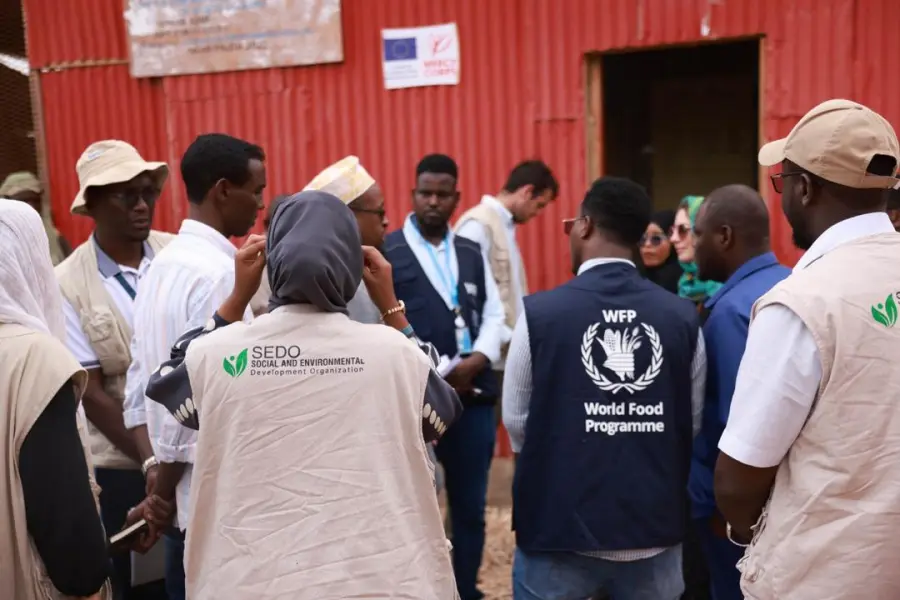
Puntland, Somalia: For years, school children in Puntland went to class hungry. Families struggled to afford nutritious food. And smallholder farmers grew vegetables with nowhere reliable to sell them. The Home-Grown School Feeding (HGSF) program known locally as KAABE is changing that. Implemented by SEDO Somalia with support from the World Food Programme (WFP) and funded by French Humanitarian Action, the project is built on a simple but powerful idea: provide school children with safe, diverse, and nutritious food sourced directly from local farmers. Children eat well. Farmers earn a living. Local economies grow. It is a win for everyone.
The project officially kicked off in early 2024 with a stakeholder meeting in Bari, bringing together WFP, collaborating partners (SADAR and SDC), the Ministries of Education and Agriculture, and the School Feeding Program Coordinator. Community mobilization followed, engaging cooperatives across eight locations in Nugaal and Bari. A comprehensive list of 450 cooperative farmers was finalized for training, and sessions on Good Agricultural Practices (GAP), post-harvest loss reduction, and food safety began in January 2024 and continue to roll out across all target locations. To ensure farmers could fully understand the training, the GAP manual was translated into Somali. Meanwhile, SEDO participated in partner onboarding training, and farmer cooperatives were successfully linked to 26 schools under WFP support, enabling the delivery of fresh produce directly to school cafeterias.
The project has gone beyond just feeding children. Training workshops on E-Shop and Scope digital tools that streamline market linkages were held in Garowe, with Scope machines handed over to cooperatives to improve transaction efficiency. Community conversations were held in Balley and Ana-Yaskah, giving farmers and families a voice in shaping the project. A donor field visit brought French humanitarian officials to Balley and Silliga Primary School, where they saw agricultural inputs farm fencing, drip irrigation, small water tanks in action, complementing the project’s water for production systems. WFP’s communication team also visited Laacdheere and Al-Amal schools, documenting success stories and capturing the moment a cooperative member delivered fresh fruits and vegetables to waiting children. Through roundtable discussions on climate change, regenerative agriculture, and market systems, SEDO continues to build partnerships that will outlast the project itself. The food system is changing one meal, one farm, one child at a time.


